
New Haven Auto Accident Attorney · June 24, 2026
Connecticut Work Zone Speed Cameras Are Now Active: What Drivers And Injured Workers Should Know
Connecticut's automated work zone speed cameras began operating June 1, 2026, including an I-95 work zone in West Haven. The warning-only period ended July 5, and CTDOT began issuing citations and fines July 6, 2026. Here is what the program means for drivers and for workers injured in a work zone.
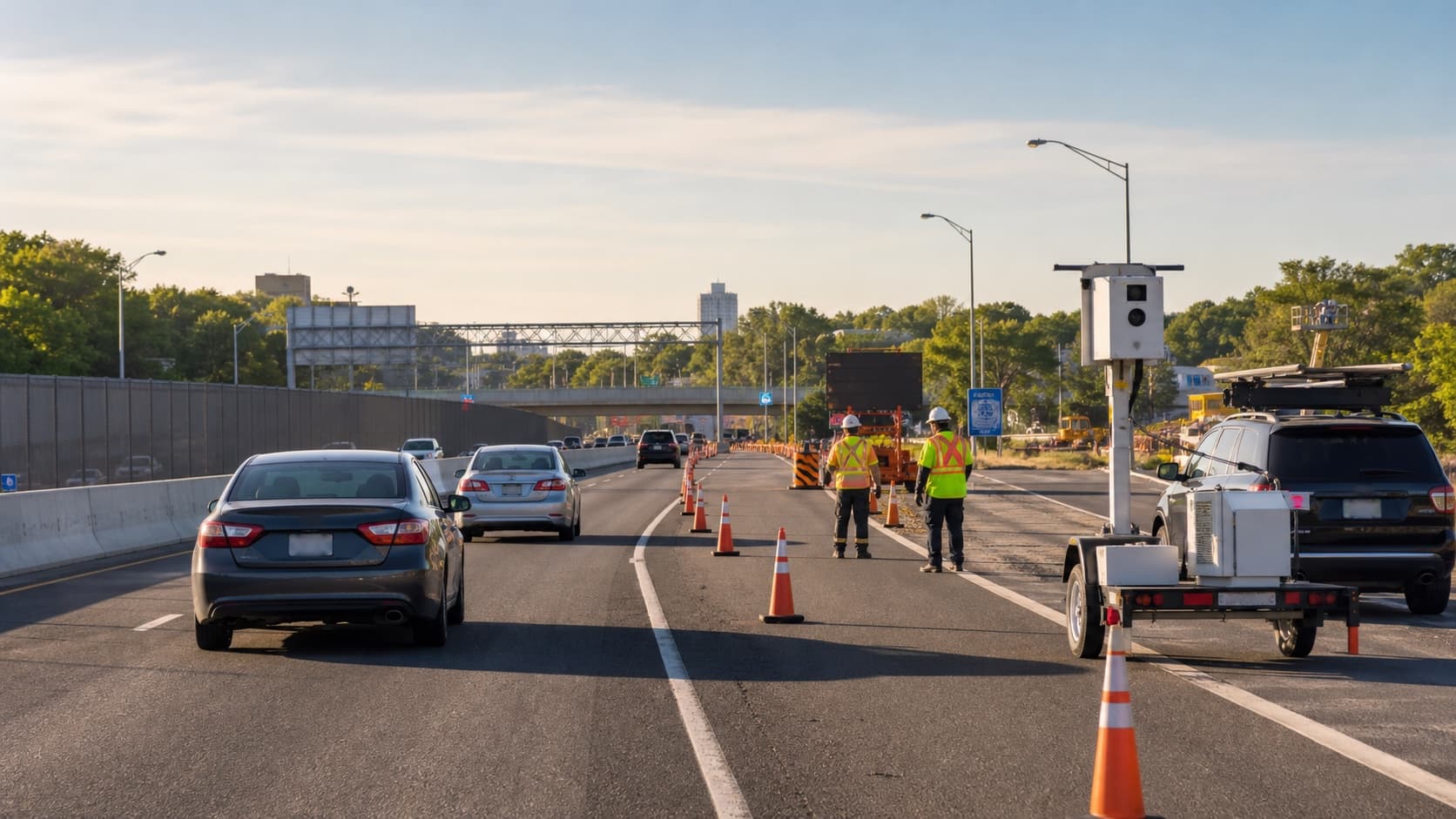
Update, July 30, 2026: The warning-only period described in this article ended on July 5, 2026. CTDOT began issuing citations on July 6, but an ordinary first offense still results in a written warning, not a fine. A second violation within one year is a $75 fine, and any vehicle going 85 mph or more gets a $75 fine even the first time. This article was published on June 24, while the warning-only period was still in effect.
In three months of testing this spring, Connecticut's new work zone speed cameras recorded more than 1.3 million vehicles speeding in highway work zones. Now they are live. The cameras began operating on June 1, and one of the first locations is an I-95 work zone in West Haven. Through July 5, 2026, drivers who speed receive a warning. Beginning July 6, 2026, penalties begin.
The program is meant to slow traffic near highway crews. It is important to remember that a work zone is not just a stretch of road with cones and a lower speed limit. It is someone's workplace. When a driver speeds through it, a crash can injure motorists, passengers, first responders, and workers standing only a few feet from moving traffic.
If you drive through the New Haven area, you move through work zones all the time, on I-95, I-91, Route 15, and local road projects. Here is what the new cameras actually do, and what a work zone crash can mean if you are hurt, whether you were behind the wheel or working on the road.
What The New Cameras Actually Do
The cameras use radar to detect vehicles traveling 10 mph or more above the posted work zone speed limit, then capture images to document the speed. State Police review each case before a notice is mailed, and facial features are masked in the images.
From March through May 2026, the cameras detected more than 8.4 million vehicles. About 1.3 million of them, nearly one in six, were speeding through a work zone, including more than 4,000 drivers over 85 mph and more than 150 over 100 mph.
A few details are worth knowing:
- The initial cameras are at I-95 Interchange 43 in West Haven, I-95 Interchange 74 in East Lyme, and Route 2 in Colchester, with more locations to come.
- From June 1 through July 5, 2026, the system issues warnings. Beginning July 6, a first offense is a written warning and a second violation within a year is a $75 fine. Any vehicle going 85 mph or more gets a $75 fine even the first time.
- CTDOT says these violations do not add insurance points and do not appear as moving violations on your driving record.
That last point matters: a camera notice is about enforcement and traffic safety, not deciding who is at fault if there is a crash.
A Work Zone Is Both A Roadway And A Workplace
Work zone crashes are different from ordinary fender benders, and the layout is part of the reason. Drivers face narrow lanes, sudden slowdowns, shifting traffic patterns, reduced shoulders, and construction vehicles entering and leaving the roadway. Workers face all of that while standing close to traffic that is often moving too fast.
That combination is why a single crash in a work zone can involve several different people and several different kinds of claims at once: a driver, a passenger, a roadway worker, and more than one insurance policy.
Why Speed Matters After A Work Zone Crash
Speed affects stopping distance, the force of a crash, and the time drivers have to react. In an injury claim, it can matter for several questions:
- Who was at fault, and by how much
- Whether a driver was acting reasonably for the conditions
- Whether another driver had time to avoid the crash
- How serious the injuries are
Connecticut also follows a modified comparative negligence rule. In general, an injured person can still recover if they were not more than 50 percent at fault, although the recovery may be reduced by their share of fault. Because speed feeds directly into that fault analysis, it can shape the whole claim.
Here is the part people get wrong. A speed camera notice may show that a vehicle was speeding, but it does not, by itself, prove who caused a crash or how badly someone was hurt. Camera data may be one useful piece of evidence. A full picture usually also needs the police report, witness statements, photos, dashcam or business-camera footage, traffic-control records, and any vehicle data. In a claim, the issue is not just what happened, but what can be proven.
If You Were Hurt Driving Or Riding Through A Work Zone
A work zone crash can look simple and still be complicated. Multiple vehicles may be involved. Drivers may disagree about who braked, merged, or followed too closely. The construction layout may have affected visibility or forced a sudden lane change.
These crashes can include rear-end collisions during sudden slowdowns, sideswipes during lane shifts, and collisions involving commercial trucks, construction vehicles, or emergency vehicles. The police report is a useful starting point, but it does not always answer every question, and it is not the final word on fault.
Summer is also peak construction season, so there are more active work zones and more traffic moving through them. When a crash involves a construction vehicle, a commercial truck, an out-of-state driver, or a rental car, figuring out which insurance policies apply can be more complicated than it first looks.
If You Were Injured While Working In A Work Zone
Roadway and construction workers face the most direct risk, and their situation often involves more than one claim.
A worker hurt by a passing driver in a work zone may have a workers' compensation claim, which generally can provide medical and wage benefits without proving fault. But workers' compensation is usually limited to the employer. If a driver or some other party caused the crash, a separate personal injury claim against that party may also need to be reviewed. Whether a third-party claim exists depends on the facts.
A few issues that can come up:
- Workers' compensation medical and wage benefits
- A third-party claim against a negligent driver
- Uninsured or underinsured motorist coverage if the driver had no insurance or not enough
- Questions about the traffic-control setup or other companies on the site
These claims have different rules and different deadlines, which is why an early review can matter.
What To Do After A Work Zone Crash
If you are involved in a work zone crash and are able to do so safely:
- Get medical care, even if you feel only shaken up. Some injuries appear hours or days later.
- Call 911 and make sure the crash is documented.
- Photograph the vehicles, lane markings, signs, cones and barriers, lighting, and the work zone layout.
- Get names and numbers for any witnesses.
- Preserve dashcam footage before it is overwritten.
- Report the crash to your insurer as your policy requires.
- If you were working when you were hit, notify your employer promptly and ask about workers' compensation paperwork.
- Be careful about early settlement offers before you know the full extent of your injuries.
Deadlines Can Be Shorter Than You Expect
Connecticut generally requires a personal injury lawsuit to be filed within two years from when the injury is sustained or reasonably discovered, with an outer limit of three years from the act that caused it. Injured workers have separate workers' compensation notice rules. And if a state road, municipal road, or public entity is involved, shorter notice requirements may apply.
Different clocks can run at the same time. That is why it helps to understand early which deadlines apply to your situation, rather than assuming there is plenty of time.
If You Were Injured In A New Haven-Area Work Zone Crash
The new cameras are a reminder of how dangerous a work zone can be. If you were hurt in one, the days after the crash can matter, whether you were driving, riding, or working on the road.
An attorney can review the police report, identify the available insurance coverage, preserve evidence before it disappears, and explain whether workers' compensation, a personal injury claim, or both may apply.
If you were injured in a New Haven-area work zone crash, contact our office for a free consultation. We can review what happened, explain your options, and help you take the next step.
Frequently Asked Questions
- When did Connecticut's work zone speed camera fines begin?
- Fines became possible on July 6, 2026, when the warning-only period ended, but an ordinary first offense still results in a written warning. A second violation within one year is a $75 fine, and a vehicle traveling 85 mph or more in a work zone receives a $75 fine even on a first offense. Before that, the warning-only period ran from June 1 through July 5, 2026.
- Where are the first cameras located?
- The initial deployments are I-95 Interchange 43 in West Haven, I-95 Interchange 74 in East Lyme, and Route 2 in Colchester. CTDOT has said additional locations will be added.
- Do these violations add points to my license or insurance?
- CTDOT states that violations under the program do not result in insurance points and do not appear as moving violations on your driving record. This does not, however, answer every legal question if someone was injured in a crash.
- Can speed camera evidence be used after a crash?
- It may be one piece of evidence. Speed can affect fault, stopping distance, and how serious injuries are, but a camera notice does not by itself prove who caused a crash. A full investigation may also need the police report, witness statements, photos, dashcam footage, traffic-control records, and vehicle data.
- I was hit while working in a work zone. Do I file workers' compensation or sue the driver?
- Start by reporting the injury to your employer and asking about workers' compensation. If a passing driver or another third party caused the crash, there may also be a separate personal injury claim. Because those claims can affect each other and follow different rules and deadlines, it is a good idea to speak with an attorney early.
This article provides general information, not legal advice for a particular case. Reading it does not create an attorney-client relationship.