
New Haven Auto Accident Attorney · September 29, 2026
Connecticut's Distracted-Driving Law Changed October 1: Work Zones, Video Screens, And What It Means After A Crash
Since October 1, 2026, Connecticut's distracted-driving law has generally barred holding a phone or having video visible while driving, with limited exceptions, and prohibited conduct in a state highway work zone can be charged as reckless driving.
Update, October 1, 2026: This article was first published on September 29, 2026, before the changes it describes took effect, and has been revised to reflect the law now in effect.
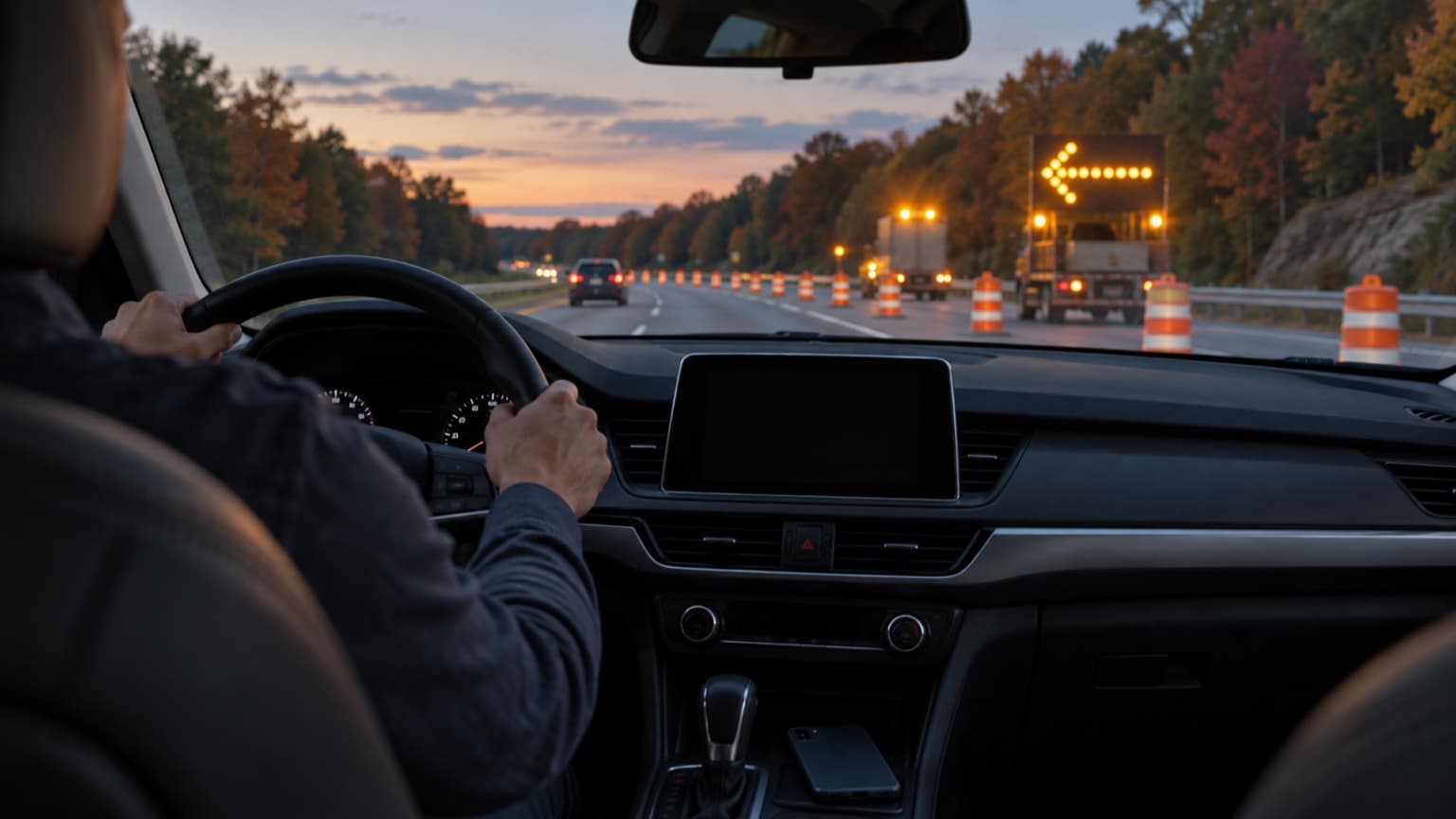
Since October 1, 2026, a driver who uses a phone or other device in a way Connecticut's distracted-driving law prohibits while passing through a state highway work zone can be charged with reckless driving. The distracted-driving law also changed that day. Holding or supporting a phone while driving is now generally prohibited, with a narrow exception for contacting emergency responders or medical providers about an emergency.
A video visible from the driver's seat is generally prohibited too, even on the car's own screen. The exceptions are a properly mounted navigation map or an image that helps with backing up, parking, seeing the roadway or detecting objects.
Public Act 26-63, § 31 rewrote the distracted-driving statute, C.G.S. § 14-296aa. Public Act 26-120 added the work-zone provision to the reckless-driving statute, C.G.S. § 14-222. For drivers on I-95, I-91 and other state highways around New Haven, the changes affect what can lead to a ticket or a criminal charge. If a distracted driver injures you, what they were doing may also matter to your injury claim.
What Counts As Distracted Driving After October 1
Under the amended § 14-296aa, a person operating a motor vehicle on a highway generally may not:
- hold or support a mobile electronic device with any part of the body;
- use a mobile electronic device, unless it is in hands-free mode;
- read, view or type a text message or other nonvoice communication on a device; or
- drive while a video or moving image is visible from the normal driving position, whether on a phone or on an installed screen.
A navigation map is allowed if the device or screen is mounted on or affixed to the windshield, dashboard or center console without interfering with driving. Images that help the driver back up, park, see the roadway or detect objects are also allowed, which covers a backup camera.
A show streaming on a phone propped in a cup holder is prohibited if the driver can see it from the driver's seat, even if the driver never touches the phone. So is a movie on a dashboard screen the driver can see. A navigation map on a properly mounted phone or on the car's own dashboard screen is not.
The law also requires drivers to maintain a proper lookout. It keeps the existing ban on activities unrelated to driving that interfere with safe operation.
"Operating" includes being stopped in traffic or at a light. It does not include being safely parked on the side or shoulder of the road. Hands-free use remains allowed for most adult drivers. The new definition of hands-free mode covers talking or listening without touching or holding the device, except for a single touch or swipe to turn a function on or off or start it. Drivers under 18, and school bus drivers carrying passengers, face stricter limits that apply even in hands-free mode. The law keeps an exception for communicating about an emergency with an emergency response operator, a hospital, physician's office or health clinic, an ambulance company, a fire department or a police department.
The fines for a distracted-driving violation stay where they were: $200 for a first violation, $375 for a second and $625 for a third or later one. The violation also appears on the driving history record, which motor vehicle insurers can obtain.
What Makes It Reckless Driving In A Work Zone
Under Public Act 26-120, effective October 1, 2026, driving in a highway work zone while doing something the distracted-driving law prohibits violates the reckless-driving statute, § 14-222.
Under C.G.S. § 14-212d, a highway work zone is an area of a state highway where construction, maintenance or utility work is being performed. It must be marked by signs, channeling devices, barriers, pavement markings or work vehicles. It runs from the first warning sign or flashing vehicle lights to the "END ROAD WORK" sign or the last temporary traffic control device. A crew on a city street is not necessarily in a highway work zone under this definition, though the ordinary distracted-driving rules still apply there.
Connecticut's work zone speed cameras issue tickets for speeding in certain work zones under a separate law. Our guide to the work zone speed cameras explains that program.
What The Charge Can Mean For The Driver
Under § 14-222, a first offense carries a fine of $100 to $300, up to 30 days in jail, or both. A later offense carries a fine of up to $600, up to one year in jail, or both. When construction work is under way in a posted construction zone, the court also adds a fee equal to the fine, for reckless driving and distracted driving alike, under C.G.S. § 14-212a. That is what the "FINES DOUBLED" road signs mean.
A reckless-driving conviction also leads to a license suspension by the DMV under C.G.S. § 14-111, as amended by Public Act 26-95, § 1, so a charge under the new provision may have consequences at the DMV as well as in court.
Prosecutors can bring the more serious work-zone charge, but the new law prohibits prosecuting a person under both that provision and the distracted-driving statute for the same offense.
If you have been charged, read the paperwork carefully and keep the court date. Our criminal defense attorneys can review what the officer wrote and what the state would have to prove.
If A Distracted Driver Hurt You
While a ticket can feel like proof, a civil injury claim still requires evidence of what the driver did and whether that conduct caused your injuries.
Evidence may include:
- What the officer saw. Connecticut's distracted-driving law requires an officer who issues a distracted-driving summons to record the specific distracted behavior observed. If the driver pays the ticket by mail, though, the payment itself cannot be used to prove what the driver did, under C.G.S. § 51-164n.
- Phone and vehicle data. Records of calls, messages or video use around the time of the crash may be obtained through the legal process in a lawsuit. Do not try to get them by asking the other driver.
- Video and witnesses. Dash cameras, nearby businesses, other drivers and, in a work zone, the workers themselves may have seen what happened.
In some cases, Connecticut law also allows damages to be doubled or tripled. Under C.G.S. § 14-295, a judge or jury may award them when the injured person specifically pleads and proves that the other driver deliberately or with reckless disregard violated a listed statute, and that the violation was a substantial factor in causing the injury. Both the reckless-driving and distracted-driving statutes are on that list. The new law does not add a separate damages remedy, and multiple damages are never automatic. It does widen the conduct that falls within the distracted-driving statute, such as a video playing on a dashboard screen.
Connecticut generally gives an injured person two years to bring a negligence lawsuit, measured from when the injury was first sustained or discovered, or reasonably should have been discovered. A separate three-year outer limit generally runs from the act or omission complained of. See C.G.S. § 52-584. Some claims have shorter notice deadlines. For example, certain highway-defect claims against the state or a municipality require written notice within 90 days. Do not wait for the criminal case to finish before getting advice.
For a negligence claim, Connecticut follows a rule called comparative negligence. You may still recover if you were partly at fault, but your recovery is reduced by your share of the fault, and you cannot recover on that negligence claim if you were more than half to blame. See C.G.S. § 52-572h.
If You Were Working In The Zone
Highway workers, flaggers, police officers directing traffic and utility crews work a few feet from moving traffic. A worker hurt by a passing driver usually has a workers' compensation claim through the employer. There may also be a separate claim against the driver who caused the injury.
Those claims have to be handled together. The employer or its insurer may have a right to be repaid from a recovery against the driver. Our articles on third-party claims after a work injury and workers' comp liens explain how that works.
What To Do Next
If you were hurt by a driver you believe was on a phone or watching a screen:
- Get medical care, even if you feel fine at the scene.
- Ask the officer for the report number, and note what you saw the other driver doing.
- Write down the names of witnesses, including any work crew nearby.
- Save photos, video and your own phone records from that day.
- Do not give a recorded statement to the other driver's insurer before you understand your rights.
If you were injured in a crash in or around New Haven, or hurt while working in a highway work zone, contact our office. We can review what happened, explain which evidence to preserve and help you decide on the next step. If you have been charged under the new law, we can review the charge and explain your options.
Frequently Asked Questions
- What changed in Connecticut's distracted-driving law on October 1, 2026?
- Effective October 1, 2026, Public Act 26-63, § 31 rewrote Connecticut's distracted-driving statute. A driver on a highway generally may not hold or support a mobile electronic device, use one except in hands-free mode, or read, view or type nonvoice messages. Video visible from the normal driving position is prohibited, except for a navigation map on a properly mounted device or screen and images used for backing up, parking, seeing the roadway or detecting objects. Drivers must also maintain a proper lookout. Separately, Public Act 26-120 makes driving in a state highway work zone while doing something the distracted-driving law prohibits a reckless-driving violation. The distracted-driving law still includes exceptions for certain emergency calls and other limited uses.
- Can I have a video playing on my car's built-in screen while I drive in Connecticut?
- Generally no. Since October 1, 2026, the amended law prohibits driving while a video or moving image is visible from the normal driving position, whether it is on a phone or an installed screen. There are exceptions for a navigation map on a device or screen mounted on the windshield, dashboard or center console in a way that does not interfere with driving, and for images that help with backing up, parking, seeing the roadway or detecting objects. The rule concerns what the driver can see, so passenger entertainment screens that the driver cannot see are a different question.
- Is using my phone in a highway work zone now reckless driving?
It can be. Since October 1, 2026, prohibited device use while driving in a state highway work zone can be charged as reckless driving under C.G.S. § 14-222, as amended by Public Act 26-120. Examples include holding or supporting a phone, using it outside hands-free mode, reading or typing text messages, or having a prohibited video visible from the driver's seat.
The distracted-driving law's exceptions still apply. Otherwise permitted hands-free calls and properly mounted navigation maps do not become reckless driving simply because you enter a work zone.
A highway work zone under C.G.S. § 14-212d is an area of a state highway where construction, maintenance or utility work is being performed and that is marked by signs, cones or barrels, barriers, pavement markings or work vehicles. The law also says a person cannot be prosecuted under both the distracted-driving statute and the new work-zone provision for the same offense.
- Does a distracted-driving ticket prove the other driver caused my crash?
- No, not by itself. A ticket or charge is an accusation, and a civil claim still requires proof that the driver's conduct caused your injuries. The officer's description of what the driver was doing, phone records and video may all become evidence. If the driver pays a distracted-driving ticket by mail, that payment cannot be used to prove what the driver did. For a negligence claim, your own share of fault reduces your recovery, and being more than half at fault bars recovery on that claim.
- I was working on the highway when a distracted driver hit me. What claims might I have?
- You may have a workers' compensation claim through your employer and, in some cases, a separate claim against the driver who hit you. The two claims need to be coordinated because the employer or its insurer may have reimbursement rights from a recovery against the driver. Report the injury and get medical care. If you'd like to talk through both claims and the deadlines that apply, contact our office.
This article provides general information, not legal advice for a particular case. Reading it does not create an attorney-client relationship.