
New Haven Personal Injury Lawyer · July 28, 2026
Hit By An E-Bike Or Scooter In New Haven: Whose Insurance Even Applies?
When an e-bike or scooter rider hurts a pedestrian in New Haven, the insurance questions look different from a car crash. These are the coverage sources worth investigating.
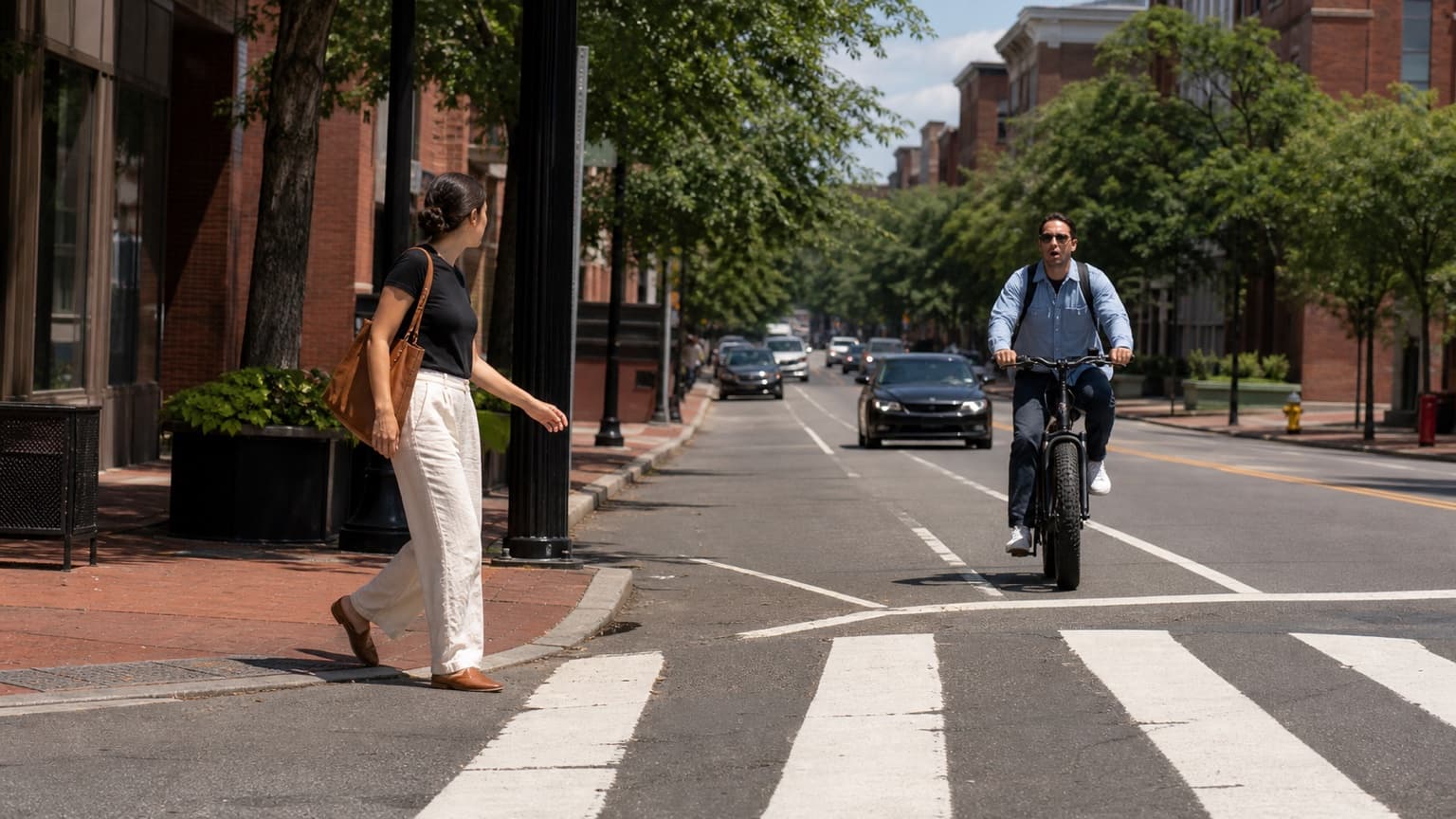
You are sitting on the curb outside a shop on Chapel Street with a broken wrist. The rider who hit you is a few feet away, apologetic, holding an e-bike. After a car crash, this is when you would exchange insurance information. There is no plate or registration here, and there may be no policy dedicated to the bike.
It is easy to assume there is no claim. Connecticut generally gives riders on the road the same duties as drivers, with limited exceptions. Fault still depends on the evidence. The harder question is often which policy, if any, will pay.
New Haven has introduced shared e-bike and electric scooter programs, which puts more of these devices on local streets. They share those streets with bicyclists and pedestrians already facing heightened summer risk. When a collision happens, the rider's conduct, the device itself, and any available insurance each have to be examined.
The Rider May Be Responsible
Under C.G.S. § 14-286a, people riding electric bicycles or electric scooters on the traveled part of a highway generally have the rights and duties that apply to drivers, subject to limited statutory and local exceptions. That includes yielding when required, obeying traffic controls, and using reasonable care.
A rider who breaks those rules and hurts someone may therefore be held responsible. The evidence still has to establish negligence, causation, and damages, and the injured person's own conduct may also be examined. If the crash happened on a sidewalk where riding was prohibited, a verified local rule may matter too.
Fault, however, is only one part of the case. You still have to determine whether insurance or another practical source of payment applies.
Finding Coverage Takes Investigation
Even when the facts support a claim against the rider, identifying a policy that covers the loss can take real investigation.
Cars generally come with mandatory liability insurance. A legal e-bike or electric scooter may not have a dedicated policy attached to it. Before concluding that no coverage exists, though, identify the device, the rider, the purpose of the trip, and the rider's household.
Where Payment May Come From
The rider's homeowner's or renter's insurance. Homeowner's and renter's policies often include personal liability coverage that can apply to negligence away from home, and that coverage may respond to an e-bike or scooter crash. Whether it does depends on the policy's terms, including how the policy treats motorized vehicles, so the policy language has to be read.
A policy in the household where the rider lives. If the rider is an insured resident of a household, that household's homeowner's or renter's policy is worth reviewing. Being a minor or living with a parent does not automatically make the parent or the policy responsible.
A rental or share platform, if one was involved. The rental terms may address insurance, responsibility, and data. Account and ride records may help identify who was riding and when. Do not assume either the coverage or the data will be there, and preserve the records early.
A business, if the rider was working. If the rider was making a delivery or performing another job, the relationship among the rider, a platform, and any employer may matter. Employment status, scope of work, and commercial coverage are fact-specific.
The rider personally. A claim may also proceed against the rider, although a valid judgment does not guarantee a practical recovery.
Your own auto policy's uninsured-motorist coverage. Whether it applies turns on the policy's definition of an uninsured motor vehicle and the legal classification of the device. Do not assume coverage exists, but do not accept a quick denial without reviewing both.
When The Device Does Not Qualify As An E-Bike
Connecticut law does not treat every vehicle sold as an "e-bike" as an electric bicycle. Under C.G.S. § 14-1, a vehicle must have operable pedals, a motor under 750 watts, and fit within one of three statutory classes. The classes differ mainly in how the motor operates and when it must stop providing power: 20 miles per hour for class 1 pedal assistance and class 2 motor-only operation, and 28 miles per hour for class 3 pedal assistance.
C.G.S. § 14-289n addresses vehicles marketed as e-bikes that fall outside those limits. A throttle-equipped device that can exceed 20 miles per hour on motor power alone does not qualify as an electric bicycle. A device designed or configured to exceed the legal limits through a switch, software change, mobile app, or similar modification also falls outside the definition. It may instead be treated as a motor vehicle, which can change the registration, operating, and insurance analysis.
That is why the device itself can become evidence. Photograph the label, motor information, controls, and any available serial number. Those details may help establish how the vehicle was designed and whether it had been modified.
What To Do At The Scene, And Soon After
These claims can depend heavily on the first week's legwork, and sometimes on the first ten minutes.
- Get the rider's name and contact information before anyone leaves. There is no plate to trace later.
- Photograph the device, including any class label or serial number, the scene, and your injuries.
- If it was a shared scooter, note the company and device number, and photograph the QR code if you can.
- Get names and numbers for witnesses.
- Report the incident to the police.
- Seek medical care, even if the injury seems minor at first.
- Note nearby businesses and cameras. Footage is often overwritten within days, and a preservation request needs to go out fast.
If An E-Bike Or Scooter Rider Hurt You In New Haven
An injury with no car involved may still support a personal injury claim. That picture has to be built piece by piece, and quickly, because riders and camera footage both disappear.
If an e-bike or scooter rider hurt you in the New Haven area, contact our office for a free consultation. We can identify the policies that may apply, preserve the ride data and camera footage while it still exists, and assess what the claim may involve.
Frequently Asked Questions
- Can I bring a claim if an e-bike or scooter rider hit me?
Possibly. A rider who was negligent, such as by riding too fast for conditions, ignoring a signal, or failing to yield, may be responsible for the injuries they caused. Fault, causation, and comparative negligence still depend on the evidence. A separate challenge is identifying insurance or another practical source of payment.
- Is there insurance for e-bike and scooter accidents?
There is no automatic answer. A legal e-bike or electric scooter may not have a dedicated liability policy, but homeowner's, renter's, household, platform, commercial, or other coverage may apply. Each possibility depends on the device, the rider's relationship to the insured, how the device was being used, and the policy language.
- Does my own car insurance cover me if a scooter hit me while I was walking?
Do not assume that it does or does not. Uninsured-motorist coverage turns on the policy's definition of an uninsured motor vehicle and on the legal classification of the device that hit you. The actual policy and the device should be reviewed before anyone gives a firm answer.
- What should I do right after being hit by an e-bike or scooter?
Get the rider's name and contact information before they leave, because there is no license plate to fall back on. Photograph the device, the scene, and your injuries, get witness contacts, and seek medical care. If it was a shared scooter, note the company and the device number. Nearby camera footage should be requested quickly, before it is overwritten.
- What if the rider just rode away?
Report it to the police right away and try to preserve what you can: witness names, camera locations, the time and place, and any detail about the rider or device. A rider who leaves is harder to find than a car, which is why the first hours matter so much in these cases.
This article provides general information, not legal advice for a particular case. Reading it does not create an attorney-client relationship.