
New Haven Personal Injury Lawyer · August 4, 2026
Injured On A New Haven Sidewalk? Written Notice May Be Due In 90 Days
A New Haven sidewalk or road injury may require formal notice within 90 days. City vehicles and state roads can follow different Connecticut rules.
If you were hurt in Connecticut, you may have heard that you have two years to sue. When a city or the state may be responsible, though, formal written notice can be due within 90 days, and missing it can bar the claim.
A fall on a defective New Haven sidewalk may require formal written notice within 90 days. The same short period can apply to a defect on a state highway. A crash involving a city vehicle may follow a different statute and a different clock. Those deadlines can arrive while an injured person is still in treatment and before anyone has determined who maintained the road.
The 90-Day Rule For Municipal Roads And Sidewalks
Connecticut has a specific law for injuries caused by defective municipal roads and bridges. Public sidewalks used for travel can also fall within C.G.S. § 13a-149 when the municipality was bound to maintain them.
Snow and ice on a New Haven public sidewalk can follow a different rule. New Haven Code § 2-87 adopts C.G.S. § 7-163a, which generally places the duty and civil liability for snow or ice on the abutting property owner or person in possession and control. The city may remain responsible if it owns or controls qualifying abutting land or if its own affirmative acts involve the sidewalk.
When an injury results from a defective municipal road or qualifying public sidewalk, C.G.S. § 52-557n generally makes § 13a-149 the only claim against the municipality for that road or sidewalk defect. A separate claim against another responsible party requires its own analysis. Calling the condition ordinary negligence does not necessarily avoid this rule. In Dobie v. New Haven, 346 Conn. 487 (2023), the Connecticut Supreme Court held that § 13a-149 remained the exclusive remedy even though a city snowplow had dislodged the manhole cover that created the road defect.
The statute generally requires written notice within 90 days of the injury. The notice must give a general description of the injury, explain its cause, and identify when and where it happened. It must also reach the proper municipal official.
There is a separate two-year period for bringing the action. The longer period does not excuse a missed 90-day notice.
The liability standard is also demanding. You must prove that the municipality actually knew or should have known about the particular defect and, after having a reasonable opportunity, failed to repair it. That concerns the municipality's knowledge of the dangerous condition, not the written notice you may have to send after the injury. You must also prove that the defect was the sole proximate cause of the injury, including freedom from contributory negligence. In practical terms, the defect must be the only legal cause of the injury. Your own negligence or another cause that combines with the defect can defeat the claim. Ordinary comparative-negligence rules do not apply in the same way to this statutory claim.
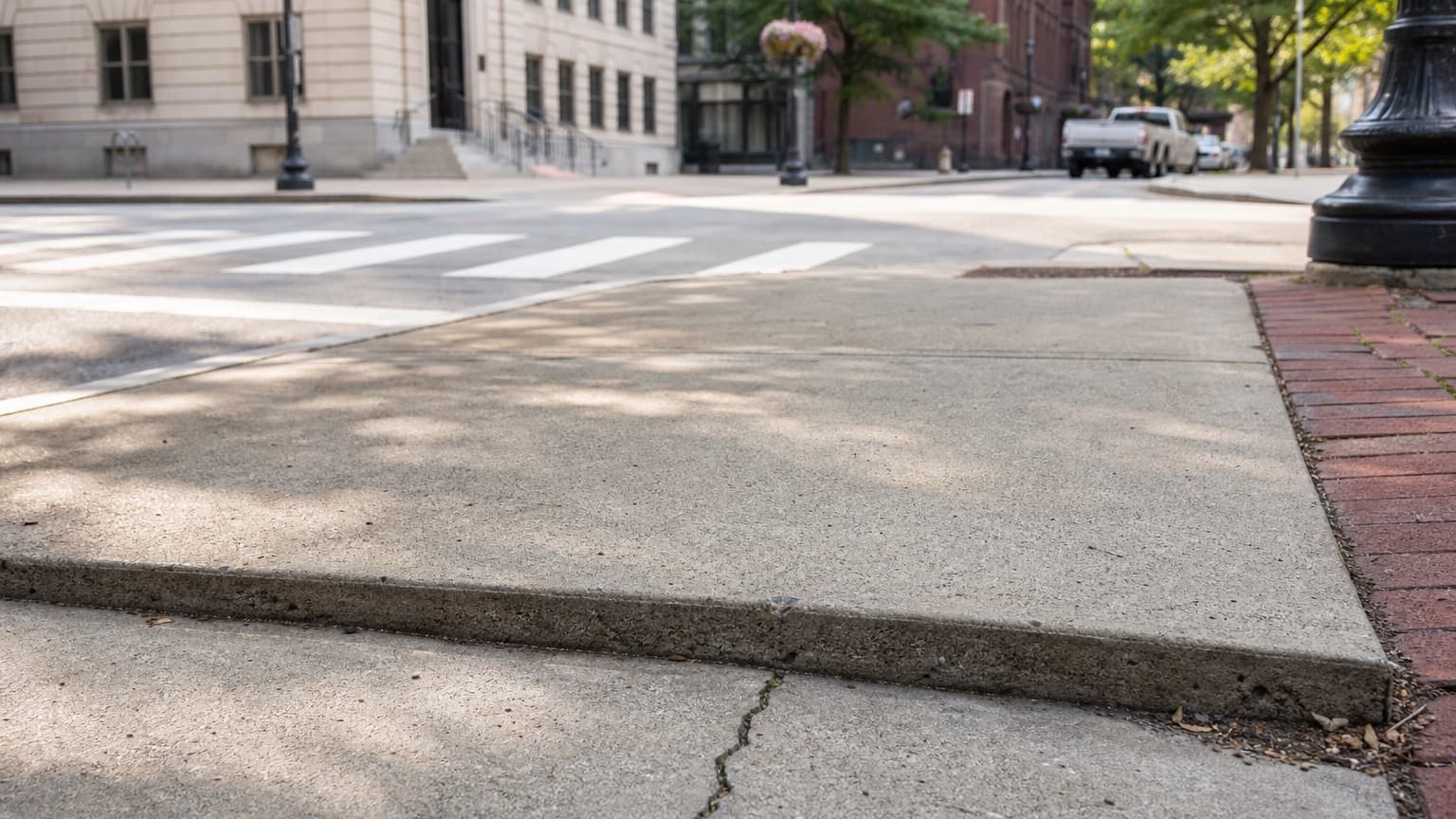
This rule can apply to a raised or broken sidewalk slab, a dangerous hole in a city street, or another condition that interferes with public travel. Coverage depends on the precise location, the nature of the defect, and which entity had the legal duty to maintain it. A fall in a private parking lot or inside a store follows a different analysis, as we explain in our article about preserving evidence after a store fall.
A Timely Notice Still Has To Be Accurate
A notice can create problems even when it is sent before the deadline. "I fell on Chapel Street" may not tell the city which condition to inspect. The block, side of the street, nearby address, and particular slab or hole can matter. So can the time of day and an accurate account of what caused the fall.
The statute has a limited savings clause for certain inaccuracies in describing the injury or stating the time, place, or cause when there was no intent to mislead or the municipality was not in fact misled. It does not excuse untimely notice, failure to have the notice timely received by an authorized official, or a notice that entirely omits a required element. Do not rely on that clause when preparing the notice. Photographs, measurements, landmarks, and a careful description should be gathered while the condition can still be found.
If C.G.S. § 13a-149 applies to a defect on a New Haven street or qualifying public sidewalk, written notice generally must reach the New Haven City Clerk within 90 days. The clerk's office handles claims against the city. That does not mean every injury in New Haven belongs in the same office. The correct recipient depends on the responsible public entity and the statute that governs the claim.
A City Vehicle Or Employee Can Mean A Different Claim
A city-owned vehicle or municipal employee can bring different statutes into play. If a city-owned truck is driven negligently, for example, a direct claim against the municipality may be analyzed under C.G.S. § 52-557n. Governmental immunity can protect a municipality from liability for certain discretionary decisions. Public Act 23-83 took effect on June 26, 2023. For incidents occurring on or after that date, this immunity is not a defense in a civil action for damages caused by the negligent operation of a motor vehicle owned by a political subdivision. That rule covers how the vehicle was driven. It does not necessarily resolve a separate decision, such as whether an officer should begin a police pursuit. Emergency-vehicle drivers retain the privileges provided by C.G.S. § 14-283, but they must drive with due regard for the safety of all persons and property.
Another statute, C.G.S. § 7-465, concerns municipal indemnification, or when a municipality may have to pay damages for which an employee is legally responsible. Governmental immunity is not a defense under § 7-465, but the statute generally applies only when the employee is legally liable, acted within the scope of employment, and the injury did not result from a willful or wanton act. For a joint claim against the employee and municipality under that statute, written notice of the intention to sue and the time and place of the injury must be filed with the municipal clerk within six months. The action must begin within two years.
These statutes can coexist. A direct claim under § 52-557n is a separate route and does not automatically carry § 7-465's six-month notice requirement. The facts determine which route applies, including who owned the vehicle, who employed the driver, what the employee was doing, and how the collision occurred.
Our New Haven auto accident attorneys can review those questions along with the police report, vehicle records, and available video.
State Highways Have Their Own Notice Rule
I-95 and I-91 pass through New Haven, but they are not city streets. A claim based on a defect in a state-maintained highway may fall under C.G.S. § 13a-144, which generally requires written notice within 90 days to the Commissioner of Transportation. The statute also treats a qualifying action commenced within the same 90 days as satisfying the notice requirement. Section 13a-144 narrowly waives the state's sovereign immunity, which ordinarily protects the state from being sued without its consent, for qualifying highway-defect claims. Courts apply its requirements strictly.
The Connecticut Department of Transportation's claims guidance likewise warns that a highway-defect claim may depend on proper notice within 90 days. CTDOT also separates highway-defect claims from claims involving a state-owned vehicle and from other claims against the state.
Do not guess who maintains a road because of its name or where the incident happened. A street inside New Haven may be maintained by the city, the state, or another entity. Maintenance responsibility can also differ among the travel lane, shoulder, sidewalk, and nearby property.
Preserve The Location Before It Changes
Public-road and sidewalk conditions do not stay the same. A raised slab may be ground down. A pothole may be filled. A work crew may replace signs or move barriers. Early photographs may become the clearest record of what was there.
If you can do so safely:
- Get medical care and follow the treatment instructions you receive.
- Take close and wide photographs of the defect, the surrounding area, and a fixed landmark that identifies the location.
- Record the date, time, weather, and exact address or coordinates.
- Save witness names, dashcam footage, and any vehicle number or license plate.
- Keep the shoes and clothing you were wearing without altering or washing them.
An attorney can identify the correct statute, investigate the public entity, preserve the scene, and determine whether a formal notice is required. That work has to start before the applicable deadline passes.
If You Were Hurt On A Public Road, Sidewalk, Or By A Government Vehicle In Greater New Haven
A municipal road or qualifying sidewalk defect claim may require written notice within 90 days. A joint employee-indemnification claim under § 7-465 requires notice within six months, while a direct § 52-557n claim follows a different procedural route. Our New Haven personal injury attorneys can investigate who controlled the location or vehicle and which rule may apply.
Contact our office for a free consultation. We can review the available records, help preserve the evidence, and explain the next steps while the applicable deadlines are still open.
Frequently Asked Questions
- How long do I have to sue the City of New Haven for a sidewalk injury?
A lawsuit under Connecticut's municipal highway-defect statute generally must be brought within two years of the injury, but written notice must reach the New Haven City Clerk within 90 days if C.G.S. § 13a-149 applies. The two-year period does not extend the earlier notice deadline. Whether the statute covers a particular sidewalk and which entity was bound to maintain it require a fact-specific review.
- What has to be in the 90-day notice?
Connecticut's municipal highway-defect statute calls for a written general description of the injury, its cause, and the time and place where it happened. The notice also has to go to the proper recipient. A vague or misdirected notice can create a serious problem, so photographs, measurements, and a precise location should be preserved promptly.
- What if I was hit by a city truck or injured by a city employee?
Municipal-vehicle and employee-negligence claims can proceed under different statutes. For a joint claim against the employee and municipality under C.G.S. § 7-465, written notice of the intention to sue and the time and place of the injury must be filed with the municipal clerk within six months, and the action must begin within two years. A direct claim against a municipality under C.G.S. § 52-557n follows a separate route and does not automatically carry the § 7-465 notice requirement.
- What if the defect was on I-95 or another state highway?
A claim based on a defect in a state-maintained highway may fall under C.G.S. § 13a-144. That statute generally requires written notice within 90 days to the Commissioner of Transportation. Ownership and maintenance responsibility should be confirmed rather than assumed from the road's location.
- I already missed the 90 days. Is my case over?
Not necessarily. The 90-day statutes may not govern your injury, and another responsible party, such as an abutting property owner or contractor, may be subject to a different deadline. Have the facts reviewed immediately rather than deciding on your own that the case is over.
This article provides general information, not legal advice for a particular case. Reading it does not create an attorney-client relationship.